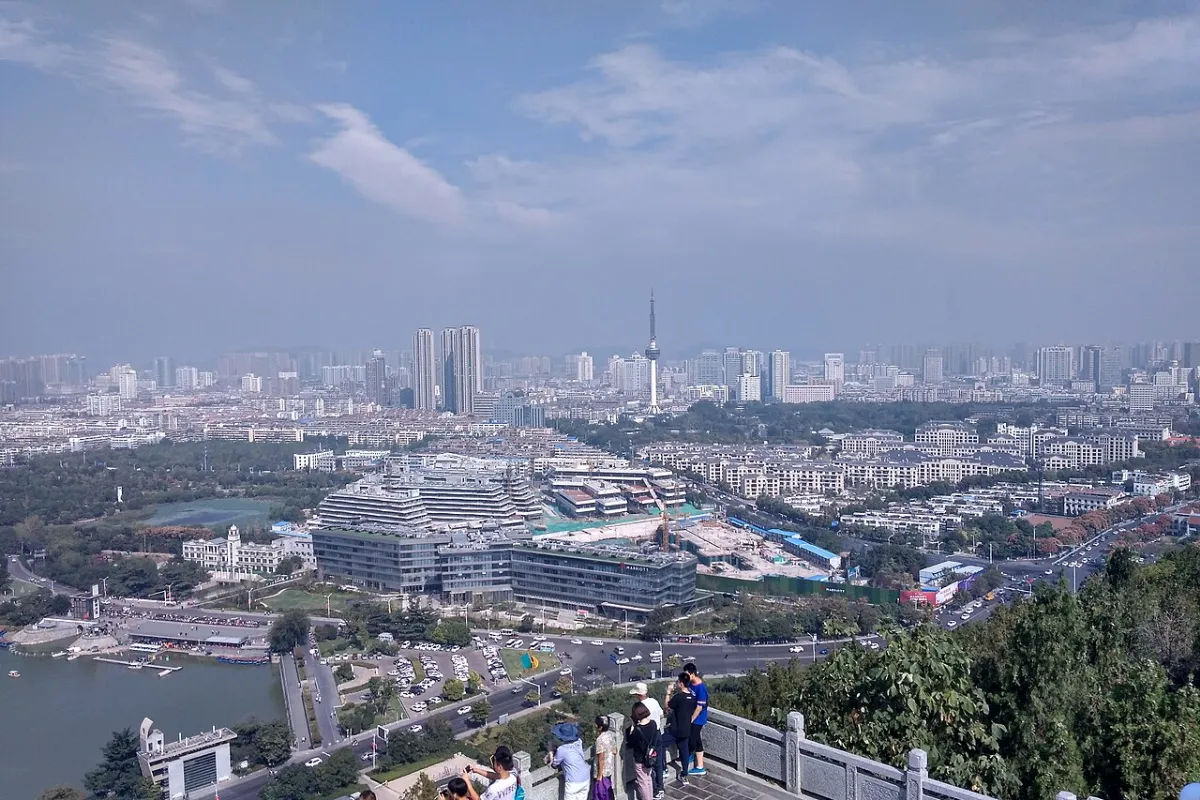
Why this place
Xuzhou was the power base of the Liu family that founded the Han dynasty, and the hills around it are honeycombed with Han tombs — including a burial cut into a mountain with dozens of linked chambers and a terracotta army of a different scale. The city later sat on the north–south and east–west railways, which made it a strategic prize in every modern war. For travellers it is above all an archaeology stop: jade suits, stone reliefs and a smaller but genuine terracotta army.
People and culture
- Xuzhou was the homeland of the Han founder Liu Bang's kin, and the local tombs are the richest Han burials outside the imperial capital, which is why the museum holds a jade burial suit sewn with gold wire.
- The Guishan tomb was cut by hand out of a limestone hill into more than fifty chambers, with a level floor and aligned passage that still puzzles engineers.
- The Han terracotta army at Shizishan is a provincial version of Xi'an's: smaller foot soldiers and court figures, but a real army meant for the next world.
- Xuzhou's stone carved reliefs show Han everyday life — cooking, hunting, music — and are the main visual record we have of how ordinary people lived then.
- The city was a railway junction from the early twentieth century and changed hands repeatedly in the wars of 1938 and 1948, which is why its centre is newer than its tombs.
What to see
- The Han Terracotta Warriors pit at Shizishan, smaller figures but a genuine buried army
- The Guishan Han tomb, hollowed out of a hill with more than fifty chambers
- The Xuzhou Museum, which holds the jade burial suit of the Chu king
- Yunlong Lake and the Yunlong Mountain park on its western shore
- The Han culture exhibition hall at Lion Mountain, for the relief carvings
- Huaihai Campaign memorial, for the 1948 battle fought here
What to eat
- Xuzhou mutton soup, a peppery northern-style broth eaten at breakfast
- Guokui flatbread baked on a convex pan, sold at every corner
- The local barbecue, which is heartier and spicier than the Jiangnan style
- Mianjin (wheat gluten) braised in brown sauce, a northern Anhui border dish
How to plan
Spend a morning at the Xuzhou Museum for the jade suit and the Han gold, then take a taxi to the Guishan tomb to walk the cut-stone chambers. Afternoon goes to Shizishan for the terracotta army and the relief carvings. A second day can be Yunlong Lake and mountain, or the Huaihai memorial if wartime history interests you. Xuzhou is a major rail hub, so it is an easy break on the Beijing–Shanghai line.
Best time
April–May and September–October
Practical tips
- The Han tombs are spread across the hills outside the centre; use a taxi and group nearby sites in one trip.
- The jade suit and the best bronzes are in the museum, which closes for lunch — go before noon or after two.
- Xuzhou food is northern and spicy; if you want mild Jiangnan cooking, say so when you order.
HSKHSK level 3
This browser has no speech synthesis, so the ▶ buttons stay silent. Everything else works — Chrome, Edge and Safari can read the sounds aloud.