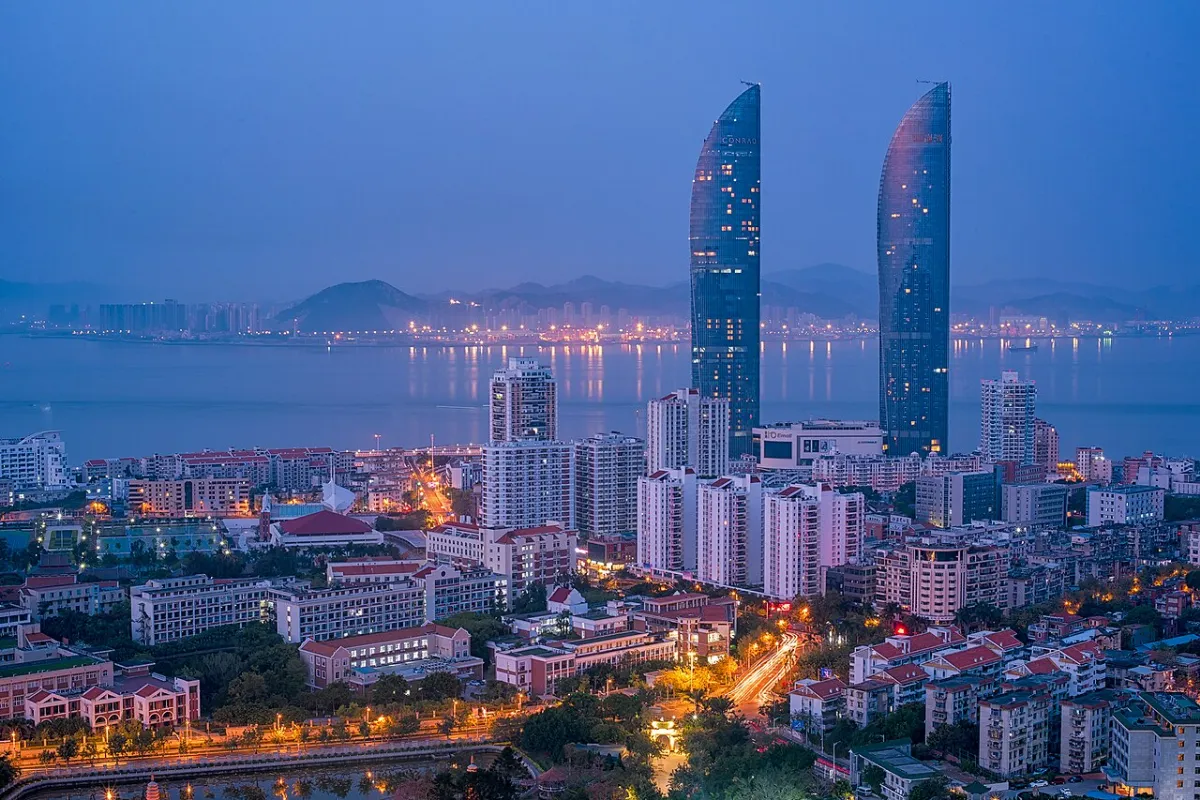
Why this place
Xiamen is a port city on the southeast Fujian coast, built around a sheltered harbour whose Gulangyu islet was shared by a dozen foreign legations from the early 1900s. The old streets still mix Minnan lane houses with red-brick mansions, and Xiamen University, founded in 1921 by the overseas-Chinese philanthropist Tan Kah Kee, sits between the sea and a hillside temple. The city is also the usual jumping-off point for the earthen tulou fortress-houses of the inland hills, two to three hours away by road.
People and culture
- Xiamen grew from a fishing islet called Amoy; in the 17th century the Ming loyalist Zheng Chenggong, known as Koxinga, used it as his base to campaign across the strait, and his fortified stronghold on Gulangyu is now a memorial hall open to visitors.
- Tan Kah Kee, born in the nearby village of Jimei, made his fortune in rubber in Singapore and gave it back as schools — the enormous Jimei School Village and Xiamen University are his buildings, in a distinctly overseas-Chinese red-brick style.
- The Minnan dialect and its music run through local life; the Nanyue ensemble and the glove-puppet theatre are still taught in the old city, and the Hokkien-speaking diaspora across Southeast Asia traces its home speech to this coast.
- Xiamen was one of China's first Special Economic Zones in the 1980s, and its container port at Haicang is among the busiest on the strait — the city's present wealth is newer than its colonial architecture suggests.
What to see
- Gulangyu island reached by ferry, a car-free islet of consulate villas, the Sunlight Rock viewpoint and a piano museum; go early to beat the day-trippers
- Nanputuo Temple, a working Buddhist monastery at the foot of the Wulao (Five Old Men) peaks, beside Xiamen University
- Xiamen University's lakeside campus and the nearby Hulishan Fortress, whose late-19th-century Krupp cannon still points at the sea
- Zhongshan Road pedestrian street and the Eight Market (Bashi) the old Chinese quarter, best for street food at dusk
- Jimei, Tan Kah Kee's home village, with the dragon-shaped returned-overseas school buildings and his tomb
- The tulou cluster at Tianluokeng and Chuxi, two to three hours inland by car the round Hakka earthen houses, a UNESCO site
What to eat
- Oyster omelette (ha li jian) eggs and sweet-potato starch bound with fresh oysters, a Xiamen street classic
- Satay noodles (sha cha mian) a broth of ground peanut and shrimp paste with noodles and your choice of toppings
- Peanut soup (hua sheng tang) with fried dough sticks, the city's usual breakfast
- Steamed seafood from the strait razor clams, mantis shrimp and grouper, sold by weight at the markets
How to plan
Three days. Day one on the island: ferry to Gulangyu first thing, walk the villa lanes and climb Sunlight Rock, back before the afternoon crowds. Day two in the city: Nanputuo Temple and the Xiamen University lake in the morning, then the Hulishan Fortress and the coastal road to Shapowei; finish at the Eight Market for dinner. Day three a day trip inland to the tulou at Tianluokeng, or a slower morning on Gulangyu and an afternoon in Jimei.
Best time
March–May and October–December; typhoon season is July–September
Practical tips
- Gulangyu limits the number of day visitors — book the ferry from the International Ferry Terminal (not the local one) a day ahead in peak season
- The cross-strait ferries to Taiwan, China and to Kinmen leave from Xiamen; bring your documents and allow time at the terminal
- The island core is packed between 10am and 4pm; stay overnight on Gulangyu or visit at opening to have the lanes to yourself
This browser has no speech synthesis, so the ▶ buttons stay silent. Everything else works — Chrome, Edge and Safari can read the sounds aloud.