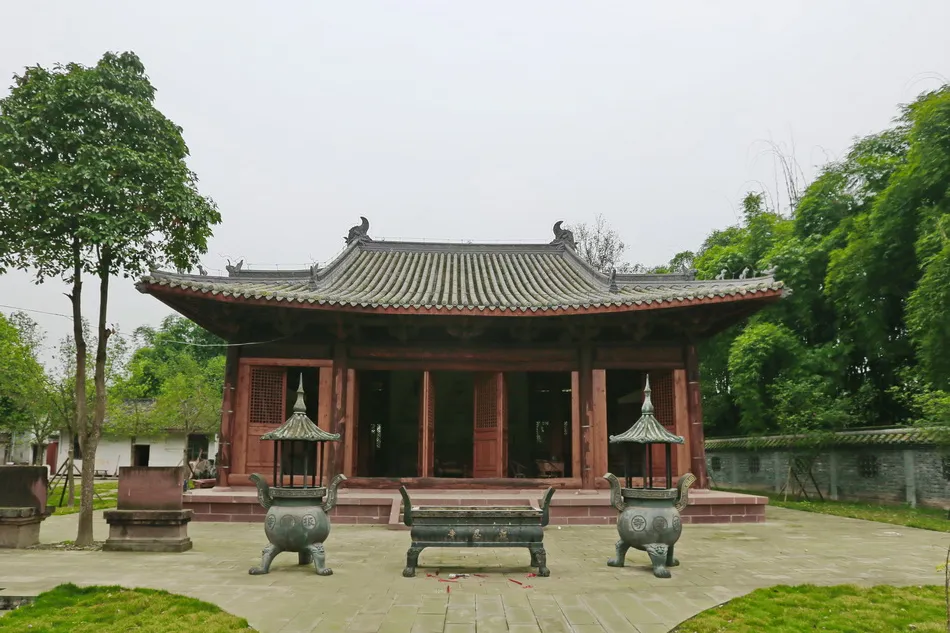
Why this place
Meishan is the birthplace of Su Dongpo, Su Shi, the Song poet, painter and official who is probably the most universally loved figure in Chinese literary history. His family home and the memorial halls are the main reason to come, and the surrounding plain is also known for bamboo weaving and a quiet rural Sichuan character between Chengdu and Leshan, with mulberry and tea fields along the roads.
People and culture
- Su Dongpo, one of the greatest Song-dynasty poets, was born in Meishan, and the Su family produced three major literati across two generations, father and two sons.
- The Sansu Temple honours the father Su Xun and his two sons, Dongpo and Su Zhe, as a family of letters with a preserved study and garden.
- Meishan bamboo weaving is a national intangible heritage, making fine baskets and even artworks from split bamboo thinner than thread.
- The local food named after Dongpo reflects the family cultural prestige carried into the kitchen, with braised and slow-cooked dishes.
- The plain around Meishan is classic central Sichuan farmland, and the literati tradition shaped local schools and gazetteers for centuries.
What to see
- The Sansu Temple, the Su family residence and ancestral hall, set in a quiet garden with old trees.
- The Meishan bamboo weaving workshops, where split bamboo is turned into fine craft and demonstrated.
- The Longquan hills and the central Sichuan plain villages around the city, good for a drive.
- The Dongpo Mid-Lake, a city park named for the poet with a calm lake and pavilions.
- The old town lanes and the Ming-era city wall remnants near the centre.
- The nearby Pengshan, with an old tomb and hot springs in the hills to the south.
What to eat
- Dongpo-style dishes, braised pork and fish named after the poet, served at local restaurants.
- Sichuan cooking with the local qingyi river fish, fresh and lightly spiced with pickled greens.
- Bamboo shoots and bamboo-based dishes from the weaving-country hills in season.
- Pickled vegetables and the plain home cooking of central Sichuan, mild and comforting.
How to plan
Day 1: the Sansu Temple in the morning, then the bamboo weaving workshops and a walk through the old lanes and the Dongpo park. Day 2: a countryside loop to Pengshan for the tomb and hot springs, or simply enjoy the local food and the riverside. Meishan is on the Chengdu to Leshan rail line, so it works as a half-day literary stop between the two bigger cities rather than a long stay, and you can return the same day.
Best time
March to May and September to November; the bamboo country is green in summer.
Practical tips
- The Sansu Temple is the reason to stop; give it a slow morning and read the bilingual panels.
- Meishan is between Chengdu and Leshan by rail, so visit as a break rather than a destination.
- Bamboo weaving is best seen in a working workshop; ask at the tourist desk for one open to visitors.
HSKHSK level 3
This browser has no speech synthesis, so the ▶ buttons stay silent. Everything else works — Chrome, Edge and Safari can read the sounds aloud.