Why this place
Kaifeng was the capital of the Northern Song and in the eleventh century it was probably the largest city on earth, with over a million people and a lively night economy recorded in the famous scroll of the Qingming Festival. The Yellow River has buried the old city under silt several times, so the Song capital lies beneath the modern streets, yet the mood - the lakes, the night markets, the temple fairs - still recalls a water city of canals. It is also a city of Jewish and Muslim history, with a synagogue tablet from the Ming.
People and culture
- Kaifeng was the Northern Song capital from 960 to 1127, the centre of a fully commercial society with paper money, theatres and the world's first night markets open past curfew.
- The Qingming Scroll, painted by Zhang Zeduan, shows Kaifeng's bridges, boats and crowds in such detail that historians use it as a record of Song urban life.
- A community of Jews lived in Kaifeng from the Song or Yuan period and built a synagogue whose inscribed stone still survives, describing their law in Chinese.
- The city was the eastern terminal of the Grand Canal's grain route, which is why the Song court could feed a million people far from the rice south.
What to see
- The Iron Pagoda, a 55-metre glazed-brick pagoda of 1049 that has stood through floods and earthquakes.
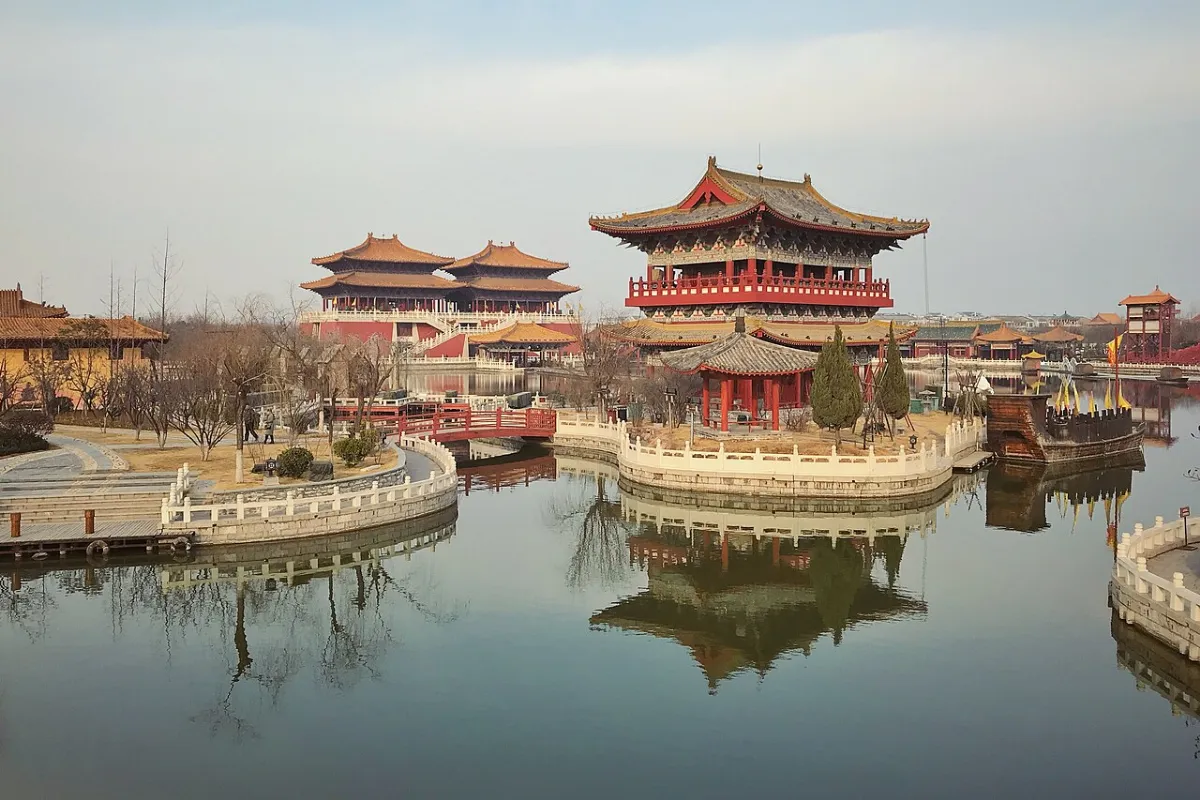
- Millennium City Park, a large reconstruction of Song Kaifeng with boats, markets and the Qingming-scroll street plan.
- The Dragon Pavilion on the site of the imperial palace, with the connected city lakes.
- Xiangguo Temple, once the largest Buddhist monastery in the country and still active.
- The Kaifeng Jewish synagogue tablet, a Ming stone recording the community's story.
- The Yellow River dyke park north of the city, marking where the river has overtopped the town.
What to eat
- Soup dumplings (guantang baozi), the breakfast dumpling filled with hot broth, eaten carefully to avoid scalding.
- Almond tea and fried jelly, classic Gulou night-market snacks.
- Spiced beef and braised noodles, sold by families who have worked the stalls for generations.
- Wonton and peony-shaped cakes, the latter a nod to the city's flower.
How to plan
Spend two full days. Day 1: the Iron Pagoda in the morning, then the Dragon Pavilion and the connected lakes, finishing at the Gulou night market for dinner. Day 2: Millennium City Park to walk the reconstructed Song city, then Xiangguo Temple and the Jewish synagogue tablet, ending with a boat on the city lakes. Kaifeng is an hour by high-speed rail from Zhengzhou, so you can stay there and day-trip, or take a second base in the old town to enjoy the evening markets after the day-trippers leave.
Best time
April-May and September-October; the night markets are at their best in autumn
Practical tips
- Kaifeng is 30 minutes by high-speed rail from Zhengzhou - visit as a day trip but stay one night if you want the night market at ease.
- The Gulou night market gets crowded and prices rise for tourists; walk two streets back for the same food at local cost.
- Millennium City Park is a reconstruction, not ruins - go for atmosphere, not archaeology, and avoid the national holiday weeks.
HSKHSK level 3
This browser has no speech synthesis, so the ▶ buttons stay silent. Everything else works — Chrome, Edge and Safari can read the sounds aloud.