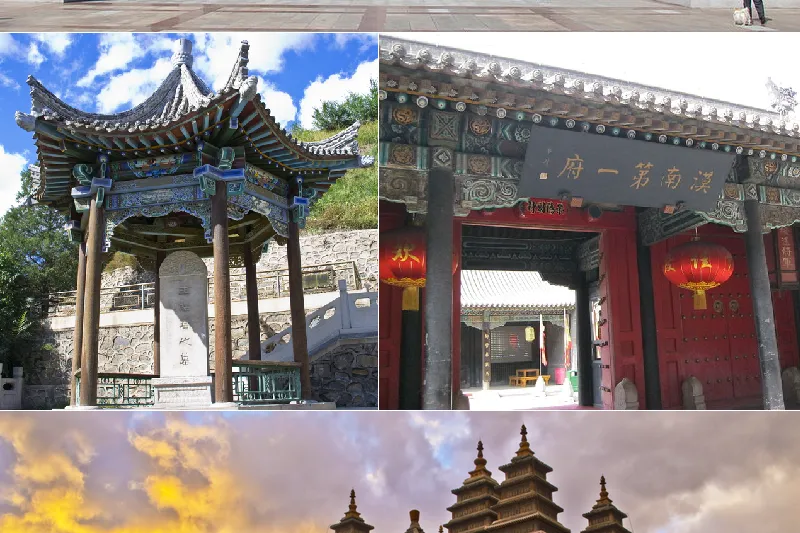
Why this place
Hohhot means 'blue city' in Mongolian, and it has been the main city of Inner Mongolia since the Ming dynasty. It is where Mongolian, Chinese and Tibetan Buddhist traditions meet — the temples in the old town are older and less reconstructed than almost anywhere else. It is also the natural starting point for the grasslands north of the wall, so most Inner Mongolia trips begin here with a temple morning and a grassland afternoon.
People and culture
- Hohhot was founded in the 1570s by the Mongol leader Altan Khan, who built the Dazhao Temple and made this a Buddhist centre on the steppe edge.
- The name means 'blue city' in Mongolian, a rare case where the Chinese form keeps the Mongol meaning rather than translating it.
- The Five Pagoda Temple carries a wall of 1,563 carved Buddhas and an early astronomical diagram, a Ming–Qing blend of faith and science.
- The Inner Mongolia Museum is the best single place to read the steppe layers — Xiongnu, Xianbei, Liao, Mongol — that built the north.
What to see
- Dazhao Temple, built in 1580, with a silver Buddha and Ming-dynasty dragon carvings
- The Five Pagoda Temple, with a wall of 1,563 carved Buddhas and astronomical diagrams
- Inner Mongolia Museum, the best place to understand the steppe, Xiongnu and Mongol layers
- The grasslands at Xilamuren or Huitengxile, 1–2 hours out
- Zhaojun Tomb, the Han princess's burial mound south of the city, tied to a peace marriage
- The old mosque and the Hui quarter, for halal food and the city's Muslim side
What to eat
- Hand-cut mutton (shouba rou) boiled, eaten with salt and your fingers
- Milk tea with salt, and milk skin, milk tofu and other dairy
- Roast whole lamb for a group, and koumiss (fermented mare's milk)
- Shaomai steamed mutton dumplings eaten for breakfast in the old town
How to plan
Spend day one in the city: Dazhao Temple and the Five Pagoda in the morning, the Inner Mongolia Museum after lunch, and the Hui quarter for dinner. Day two take a car or tour north to Xilamuren or Huitengxile grassland — ride, walk the yurts and watch the sky. A half day at Zhaojun Tomb fits on the way back. Hohhot is the rail and air hub of the region, so use it as the launch point for Baotou, Ordos and the grasslands rather than a long stay on its own.
Best time
July–September for the grasslands; the Naadam festival is in July
Practical tips
- On the grassland, the temperature drops sharply at night even in summer
- Yurts rented to tourists are comfortable but not a nomadic household — ask before expecting that
- Hohhot links by high-speed rail and air to Beijing and Baotou, so start your loop here
This browser has no speech synthesis, so the ▶ buttons stay silent. Everything else works — Chrome, Edge and Safari can read the sounds aloud.