Why this place
Bozhou is where China's traditional-medicine trade concentrates: its herb market is the largest in the country, and the city's name is attached to a famous liquor, Gujing Gongjiu, whose pits are said to be the oldest still in use in China. Hua Tuo, the legendary physician, was from here, and Cao Cao, the Three Kingdoms warlord, was born on its edge — so the place carries both the healing and the fighting ends of Chinese memory.
People and culture
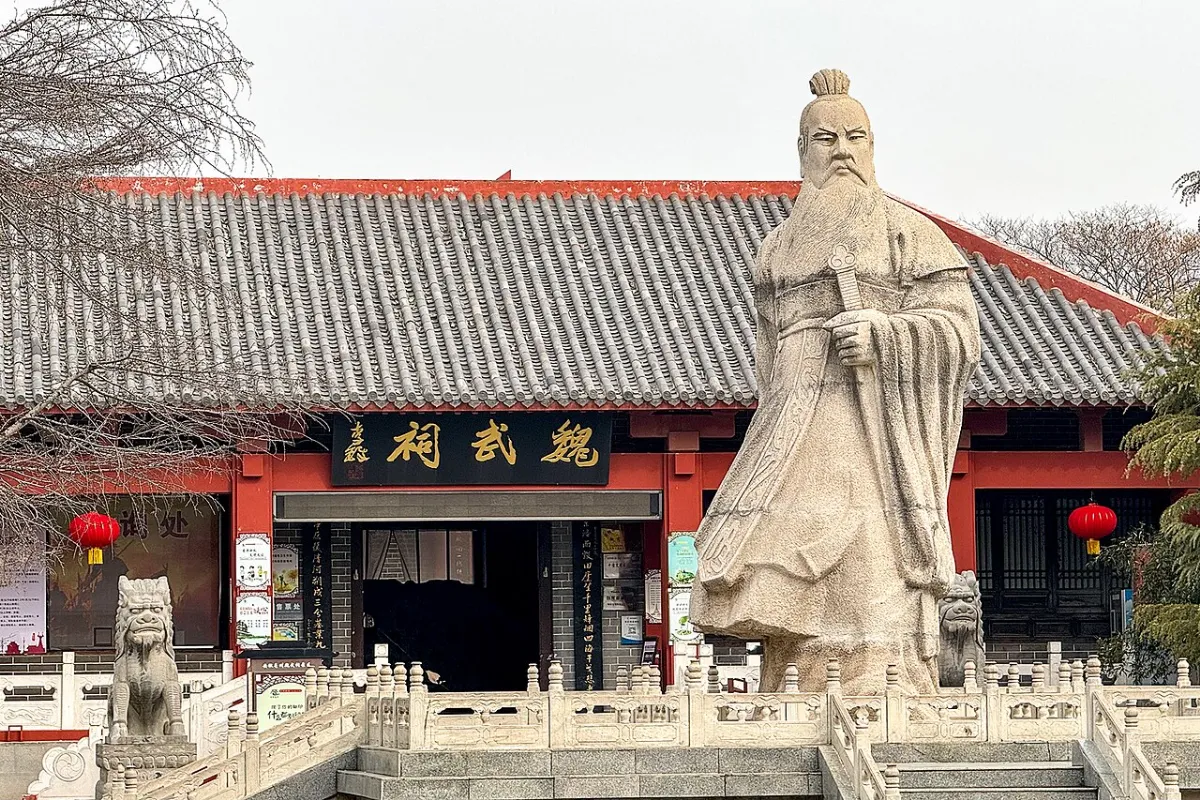
- Bozhou is the home town of Cao Cao, the warlord who founded the state of Wei and the anti-hero of the Three Kingdoms; his family's tombs were excavated on the edge of the city.
- It is also the home of Hua Tuo, the physician whose name is on the first recorded surgical anaesthetic in China — his five animal frolics routine is still taught and is on the national intangible heritage list.
- Laozi is claimed by Guoyang county and Zhuangzi by Mengcheng county, both now part of Bozhou, which makes the city a plausible cradle of Daoist thought.
- The herb trade is the living culture here: Bozhou handles a large share of China's Chinese-medicine wholesale, with stalls selling roots, bark and dried animals, and a market that starts before dawn.
- The Huaxi Tower is a Qing-dynasty theatre whose value is the carving — brick relief panels and wooden figures rather than the stage itself.
- Bozhou's name is written into Gujing Gongjiu, the liquor whose pits are said to be the oldest still in use in China.
What to see
- The Bozhou herbal medicine market, which is extraordinary if you have any interest in Chinese medicine
- Hua Xi Temple and the memorial to Hua Tuo, the Han surgeon
- The old city's Huaxi Alley and the Cao Cao underground troop-passage site
- Gujing distillery, for the liquor
- The Cao family tombs park on the city edge
- The Bozhou night market for the medicinal snacks
What to eat
- Medicinal cuisine (yaoshan) food cooked with herbs, which is genuinely local
- Beef buns and the local wheaten breakfast; Anhui-style braised dishes
- The local sesame cake and the wheat noodle soup
- The river fish of the Huai, simply steamed
How to plan
One day follows the medicine: the herb market at dawn, then the Cao family tombs and the Huaxi Tower, with the Hua Tuo memorial and the old streets if you have time. Add a half-day for the Gujing distillery and a tasting, or for the night market where the medicinal snacks are an easy way into yaoshan. Bozhou sits on the Beijing–Shanghai high-speed line, so it works as a half-day stop between Shangqiu and Hefei.
Best time
April–May and September–November
Practical tips
- The herb wholesale market starts before dawn and winds down by mid-morning — go early if you want to see it working
- Bozhou sits on the Beijing-Shanghai high-speed line, so it works as a half-day stop between Shangqiu and Hefei rather than a destination on its own
- The medicinal snacks at the night market are an easy way to taste yaoshan without a banquet; try the herb tea and the steamed buns.
This browser has no speech synthesis, so the ▶ buttons stay silent. Everything else works — Chrome, Edge and Safari can read the sounds aloud.